This website uses cookies to provide you the best experience. By continuing to use this website, you agree to the use of cookies. For more information, read the Cookie Policy
What if you could be satisfied with the Spanish you know?
Learn how to speak Spanish so you blend in with the natives.
If you speak Spanish already, but cannot always say what you want, how you want when speaking with natives, and you want to improve, read this. Every minute will be worth it (even if you have been stuck for a long time, tried everything, and lost faith).
I lived in England years ago.
My flatmate (a Spanish teacher like me, but a veteran) would watch me drag my feet, my backpack, and my soul all the way home. Every single afternoon.
When I arrived in England, I endured weeks of blank stares and awkward conversations.
I got so stuck trying to understand and interpret what they were saying that, by the time I’d finished (and inevitably come to the wrong conclusion) they were already ten sentences ahead.
I was good at coming up with sentences mentally, but when I had to speak, that all went out the window. I blurted out the first thing that came to mind and ended up embarrassed and tongue-tied.
Sounding like the intelligent adult that you are in another language is the prize at stake when you master grammar. But until that happens...
People only see a lesser version of you.
You end up feeling inferior, less valuable than everyone else.
And when everyone else are natives...
You feel you’ll never get to speak like them!
One day, that experienced flatmate of mine opened my eyes:
Me: I just want to be able to keep up with the pace of conversations without falling behind.
Her: Real life is not a language class. No one is going to change their speed or vocabulary for you.
Me: I would love to be free to enjoy chatting with them without translating in my head or obsessing over mistakes.
Her: I’m afraid you’re suffering from Death Puzzle Syndrome.

What?
As a child, I lost the lid of a puzzle which is where the completed picture was. I spent months with the pieces, in vain. Every day, you’re fitting together verbs, prepositions, synonyms… because that’s how we were taught English. Grammar here, vocabulary there… They asked us to write and speak it without having barely ever read or listened to it. We didn't have the picture of the completed puzzle!
Bingo!
I had led a peaceful live with all those textbooks and neat little structures.
I had been taught to pursue “easy solutions”.
From school all the way to university.
Because I had no alternative. Educational institutions and companies require one certificate after another. And when you get one...
It feels like you are making progress!
But when I arrived in England with my official English certificate under my arm, I discovered that I did not know as much as I had been led to believe.
That is how I started collecting all these loose little pieces in my head, without even knowing it.
All of them scattered.
I’ve spent my whole life wondering what the shortest path to fluency is. Two decades teaching English and Spanish. Countless debates with teachers across England, the U.S., and Spain.
And here’s the conclusion I’ve reached:
If overcoming the intermediate level seems impossible, it is because all the language learning scenarios I am aware of are either very artificial (like the classroom) or very extreme (like living in another country).
You’re only ever pushed two ways:
- Into the classroom, toward accuracy above all, since you must pass exams that quantify ‘how much you know.’
- Or into another country, into sheer survival mode (where no one slows down, no one adjusts, and no one behaves like you), and you've got to prove ‘how integrated you are.”
I’m afraid that no matter which path you take… you’ll end up at a disadvantage.
Because it’s always you...
You are being evaluated
(in the classroom)
or you have to adapt
(in another country).
And if you try to improve your Spanish without having solved this…
You’ll have started digging your own trench without even realizing it.
Because those around you only respond in ways that push your learning:
- When you stumble on language precision, in class
- When you mess up by not acting as expected, due to the cultural differences of living in a foreign country.
No one seems to notice your true needs:
- It’s NOT about speaking perfectly.
- It’s NOT about becoming a clone of native speakers.
You just want to express yourself in Spanish exactly the way you want, without having to give up who you are, right?
In that case…
This is about genuinely feeling that it’s okay to mess up, whether it’s vocabulary, grammar… whatever.
This is about no longer begging others to slow down or repeat themselves.
This is about being accepted without anyone expecting you to never make mistakes, always get it right… or somehow integrate all by yourself.
And no, such a place didn’t exist.
Until now.
So going forward, you could spend your time perfecting Spanish to shine in a world of scripted interactions, or push yourself to become a clone of the native speakers around you… or you could seize the chance, FOR THE VERY FIRST TIME, to fill the gaps left by both the classroom and immersion.
I'm talking about:
THE ONLY WAY
to engage with native speakers that feels like living in another country
(without actually going)
and having them adapt to your level just like a classroom
(without actually being in one).
You savour your conversations as if you understood it all, without ever needing to ask someone to slow down or repeat themselves, as if your vocabulary had no limits.
You can be yourself, even with gaps in your vocabulary and grammar.
How do you make it happen?
How do you get the best of both worlds?
How do you experience true language immersion in a safe, controlled environment?
I’ve cracked this with a one-of-a-kind strategy, which I like to call, for dramatic effect:
“The Triple Agreement”
You’ll see why it’s called that in a moment, but first…
I’d like to introduce you to a Spanish learning experience that allows you to slowly dive into the world of native speakers.
A controlled English-Spanish exchange, customized for you, all from the comfort of your own home.
The Talkaholics
It tackles what no other environment has managed to solve before.
It’s a learning environment that’s both educational and real, halfway between the safety of the classroom and the vulnerability among foreigners. The adaptation effort is shared, and the other Talkaholics embrace you as one of their own faster than anywhere else.
Any skilled teacher knows this:
When you converse, your brain starts placing the pieces of what you’ve learned, fitting them together permanently.
(true language experts -teachers and linguists- won’t hesitate to tell you so).
Here we converse in Spanish and English through what I call the “The Triple Agreement”.
First:
You engage as equals (you teach them, they teach you). You’re no longer just someone being assessed—like in a classroom—or someone who has to adapt—like in a foreign country-. You become essential to those learning your language. They’ve never relied on you like this before.
Second:
You gain autonomy as a learner because, through guided practice, you discover how the brain learns languages and builds stereotypes in sequence.
Third:
You become skilled at navigating potential misunderstandings, something unachievable in a classroom (no natives) and impossible abroad (no mediators by your side). Here, you count on me to mediate both linguistically and culturally.
In short:
You move from pleading for attention to being the focus, from feeling abandoned to being looked after, from being judged for your mistakes to having them explained to you. You finally feel like you belong.
You are on the same level as the native speakers in the group you want to be part of.
Here’s my approach:
I guide you through alternating English-Spanish exchanges, both in one-on-one pairs and in groups.
One week, you converse with a native speaker just for you -supported by a reference guide for non-teachers- and the next, you come together with other pairs in live sessions with me.
About the partner exchanges:
-You get access to a reference guide for non-teachers filled with activities and guidelines to help your partner exchanges run smoothly.
-The guide is intuitive, letting you see both sections at a glance:
- Activities ready for immediate use, designed for non-teachers.
- Step-by-step instructions on effective language learning, ready to apply instantly.
- Pick the activities that excite you most and carry them out, applying powerful, coherent learning strategies.
About the group exchanges:
- Live group exchanges form the core of the Talkaholics program.
- They happen every two weeks and last 2 hours.
- I’ll guide you through common myths about language learning and show you how to navigate cultural clashes.
- You’ll be part of a small, select group of participants.
When the group kicks off, you’ll be fully prepared, because I meet with each pair beforehand to tackle the concerns of both you and your partner.
You might spend ages deciding whether to focus on Spanish or do something else, except when your Spanish time becomes that “something else” you most want to do. Now that you’re familiar with my offer, wrestling with this choice is entirely optional.
I always knew that my students longed to chat with peers, and teachers aren’t peers. That’s why, when I started teaching Spanish and English online, I brought them together to practice with each other with my guidance.
And there’s one thing they all keep repeating to me:”
“Seeing them make mistakes in my language takes the pressure off me to speak in theirs.”
Some had participated in partner exchanges before, but NEVER with a written reference guide for non-teachers.
Others had joined group exchanges -usually in bars- but NEVER in a group this cohesive, nor with activities this carefully designed and structured.
By combining classes and immersion like this, they’ve been able to achieve results they couldn’t reach separately. Just two examples:
First:
Native speakers, much like doctors, use specialized jargon with each other and simplified language with everyone else. When two natives chat in front of someone who isn’t, that person can feel completely out of place. Not so in The Talkaholics:
Here, you engage in 100% natural conversations between native speakers, rich with striking colloquial nuances, and you learn to process them with my guidance and targeted exercises.
Second.
Spanish-speaking participants sound more American when talking with Americans, and more British when talking with the British. Sure, the accent rubs off, but that’s not the whole story.
Just like rappers, hipsters, or skaters adopt the style and slang of their tribe, linguists believe that language learners copy the intonation of the group they aspire to join, not that of their teachers!
Achievements like these have allowed The Talkaholics to make a real difference in the participants’ lives. And it can have the same effect on yours too (consider that you’ll be engaging in a way that very few have tried before).
A way that doesn't exist in the outside world but that nevertheless prepares you to be in it.
-It’s only once you participate that you realize just how much exchanges focused almost entirely on debating topics can be enhanced.
- You realize that treating an exchange as just a language lesson between native speakers is like believing that the key to a soccer game is simply chasing the ball.
- Couples don’t always get along the way they’d like, and the same goes for your attempts to produce messages that others can understand: just because you intend to make them clear doesn’t mean you’ll succeed. Luckily, linguists have a few remedies, and we’ll be looking at them together.
- If you’ve found yourself fixating on the mistakes you keep making -the ones that just won’t go away- you’ll be delighted to discover what you actually can (and can’t) do about it, and how to turn that fixation into acceptance so you can live with more ease.”
- You’ll gain access to my in-depth answers to the kinds of questions participants often ask, questions that learners who’ve never experienced an exchange almost never think to ask.
- You realize there’s a way to correct your partner that goes beyond the old “you don’t say it like this, you say it like that”. It’s a method shown to be more effective, yet one that many still overlook.
- I’ll share the biggest mistakes I see participants in the exchanges make when they try to smooth over a blunder that has upset their partner from another country.
- You’ll discover a rarely used approach to building cultural understanding. One that doesn’t require you to act just like natives, yet still lets you connect with them without giving up your own identity.
- The online and in-person worlds call for different skills. What’s surprising is that the very skills you hone online are the hidden strengths of many people, only they don’t realize it.
- You learn how to repeat a message in a way that keeps you from having to repeat it again.
- You’ll discover how to teach your partner and learn from them without relying on those tired activities—filling in blanks, parroting patterns—hoping they’ll somehow stick. (If you’ve come this far, I trust you’ve already seen they don’t work.)
Once you’re comfortable engaging with native speakers, following the non-teachers’ guide, applying its strategies, and seeing results from the ready-to-use activities…
You learn to customize your learning so radically that going back to the old way is simply impossible.
But let me be clear:
The exchanges aren’t magical, and I want you to really grasp that. Moving confidently among native speakers depends on a few other things.
Still, the foundation you build through them is one of the most powerful tools you’ll have at your disposal as you continue your path to language learning success.
What qualifies me to help you
If you don’t give what I offer a try... you’ll never know whether what you’re missing was truly worth it.
All I can do from here is share what happened after living in England, after realizing that the classroom alone wasn’t enough to prepare me for this kind of experience.
I’ve made every mistake I’m about to save you from, and in the long run, it’s given me a real advantage.
I went on to teach in schools in England and the United States, and while watching veteran Spanish teachers -both American and British- I picked up a few valuable secrets along the way.
They’ve made me a better professional, yet I’ve never shared them openly -until now- because I had never set out to train autonomous learners so comprehensively or to mediate between cultures at this level.
Insights from two educational systems -English and American- that are very different from each other and bear little resemblance to the Spanish system.
The guided exchanges of The Talkaholics, based on “The Triple Agreement” are the result of that background and my most recent online experience.
It's been a learning curve for me.
I’ve had to take everything cultural mediators know and adapt it to the exchange context, combining it seamlessly with the language teaching strategies I excel at. A shift this radical -both in setting and participants- forces you to reinvent yourself almost entirely.
This dual expertise as both a language teacher and a cultural mediator is another reason this program is one-of-a-kind.
And just so you know, I’m not on social media or anywhere else. I’ve decided to devote my time and resources to offering this service, focusing fully on doing my job well.
If you want to join The Talkaholics...
Keep in mind that only a limited number of spots are available, given the nature of the program.
If you’re reading this page, it means I’m in the recruitment phase.
I strongly suggest that if these conditions appeal to you, you schedule an interview with me as soon as possible to see if you match the participant profile I’m seeking.
Once the program is full, the next opportunity won’t come until the next edition (date still to be determined).
Some decide to ‘go it alone:
Without the non-teachers’ guide, without anyone to clarify their doubts, without the momentum of the group. They may save money, but they pay the price in other ways.
They pay with frustration, when their partner doesn’t grasp something that seems obvious. They pay with anxiety, as they try to decode their own language, a question they’d never faced before. They pay with wasted time, because they’re unsure which activities to focus on beyond random conversation. They pay with endless hours spent hunting for practice material that’s not too hard or too easy, not too long or too short. And they pay by struggling to repair awkward cultural misunderstandings on their own.
If I were you, I’d jump in headfirst…
- If you can converse in Spanish but aren’t expressing yourself as you’d like and want to improve.
- If you’re tired of learning Spanish the hard way and want to start doing it effortlessly, without studying or memorizing.
- If you’ve learned Spanish very formally and feel it’s time to put what you know into practice with real native speakers on topics that truly interest you.
- If you’re moving abroad -for an internship, Erasmus, as a language assistant… you name it-and want to get used to different accents and avoid awkward mistakes when interacting with natives.
- If you find it hard to ‘get’ the natives you interact with daily -at work or because you live in their country -and want reliable people who speak their language to help you understand and integrate better.
- If you’ve been doing English-Spanish exchanges in pairs but improvise everything due to lack of time, and want me to plan and structure it for you, provide tailored material, and answer your questions as they come up.
- If you’re considering starting a pair-based English-Spanish exchange and want to complement it with a group experience alongside others also working in pairs.
Do NOT join…
- If you’re still at the very beginning of your Spanish journey.
- If you insist on learning through endless effort, drills, and textbooks.
- If you love fill-in-the-blank worksheets and parroting grammar patterns.
- If you only feel safe with language content neatly divided into topics and grammar boxes.
If that’s your style, you’ll get nothing out of this.
You’ve probably been fed easy, sugar-coated solutions for far too long, and that’s not how we play here. I don’t sell magic scripts that turn your words into spells. I don’t work with learners chasing that illusion.
But if that’s not you…
Don’t waste time.
Book your interview today—spots are limited and won’t be available for long.
I bet you are wondering...
Absolutely. Thanks to the guide for non-teachers your conversations have structure. Your partner knows you understand more than you can express, so they give you time to process and prepare your response. You practice as you would in real life, with active listening and strategy, and always with my live support.
You gain more than you imagine. Experts say using your native language accelerates learning the new one (we explore this in live sessions). And when you speak your own language, you’re more fluent, more natural, more “you.” Your partner gets to see your true self and connect with you on a deeper level.
Many started out just like you, but here no one is alone: everyone shares your situation and supports each other. Plus, you don’t have to improvise: activities are clear, easy to follow, with detailed instructions and all the vocabulary you need to speak.
We talk about real-life topics, not grammar rules. The activities guide you: you learn useful vocabulary and apply it in your conversations following simple steps. Since the topics revolve around your culture and your partner’s, the conversation flows naturally.
Not at all. Your partners adjust their level to yours, so you understand their Spanish as well as in class, and much better than if you met them in their country, thanks to the structure and guidance. Plus, since everyone genuinely wants to get to know each other, the conversations keep you engaged, nothing like talking just “because you have to” in a traditional class, where the topics are disconnected from real people.
Yes. You all follow the same activities, so you already know what they’ll be talking about and which words are key. These become “anchors” that help you follow the conversation. You learn expressions and jokes much faster than in a class without native speakers.
Yes. You have clear instructions in English and Spanish, useful vocabulary, and key expressions always at hand. The written format helps you process information better and serves as a reference if you get lost. Plus, the chat lets you clarify doubts with your partners instantly.
The guidelines are straight to the point and available in text or audio. The activities are simple, ready to use, and can be read in 3 or 4 minutes. Usually, one or two are done per session, and there are always several to choose from so you can pick the ones you like best.
Each interaction is guided so you can express what you want, correct mistakes without stress, and pick up cultural nuances that would take you much longer to notice on your own. You avoid misunderstandings during trips, work meetings, or meals with your foreign father-in-law. You can ask about social norms without risk. Plus, practicing in a group, not just in pairs, helps you navigate situations where you’re the only person from your country. With other participants who speak your language, you can better understand your foreign partners.
Other exchanges focus only on the language and treat culture as a superficial add-on: some history or customs, and little else. At The Talkaholics, we integrate language and culture as a whole so that communication is real and effective, avoiding the gaps and frustrations typical of other programs.
Being tall won’t automatically make you a great basketball player, and looking good won’t make you a model, though it helps. The same is true when learning from native speakers: casual chats get you by, but they won’t unlock your full potential. To truly excel, you need structure, planning, and hands-on experience. Gaining that experience on your own is costly; with me, you benefit from twenty years of expertise and thousands of hours of tried-and-tested classroom practice.
A lack of real interaction limits your learning. Talking to AI or sending voice notes on WhatsApp are just monologues, not real conversations. Real interaction involves interruptions, clarifications, and learning to manage turn‑taking, something artificial intelligence simply can’t offer. Plus, studies show we learn better when emotions are involved. Nothing beats talking to someone you genuinely like and connect with.
It’s not about cramming grammar. After just 4 or 5 sessions, you’ll notice the difference: you understand more, even when others are talking to each other because their way of speaking has become familiar. And as trust grows, so does your confidence: you move from “safe” sentences to trying new expressions, even humor. My job is to create the environment that makes that possible.
Yes. Here you develop skills that a class won’t give you: speaking confidently with native speakers, understanding slang from day one, and asking for clarification without embarrassment. You’ll arrive in another country better prepared and feeling less isolated.
Yes. Living among native speakers doesn’t guarantee you’ll understand their culture. Here, your partners explain nuances that locals take for granted, helping you avoid mistakes that could be awkward, or even serious. You integrate much faster. Keep in mind that your partners travel with you virtually, including other English speakers who might be abroad just like you.
There are no mandatory tasks for the sessions, either in pairs or in groups. However, for the pair sessions, the guide for non-teachers includes some optional activities you can prepare if you wish. This preparation involves gathering information about your country or current events to share live with your partner later.
If you think you don’t have time to learn a language, this is probably your only real solution. It’s not about finding time, it’s about having a powerful reason to stop putting it off.
The small changes that seem insignificant today are the ones that will either propel you forward… or hold you back tomorrow. The most powerful results come late: after effort and doubt, just when you’re about to give up. That’s why you need a system that supports your goal instead of relying on willpower. If each week in the exchanges you speak without fear, listen with curiosity, and feel that you can… you won’t have to fight for your goal, your system will take you there. But if your system isn’t aligned with your goal, no matter how noble it is, your day-to-day routine will sink it. Change the system, and everything else will change on its own.
Click the button below and choose the date and time that works best for you on the calendar.
To become part of Talkaholics, you must schedule your interview with me immediately. Only the fastest movers will claim one of the limited spots. Most will miss out. So don’t wait, book your interview now.
Here is everything you get when you join The Talkaholics:
Guided exchanges between Spanish and English speakers.
One week in pairs, the next in a small group.
English–Spanish exchange sessions in pairs, every two weeks:
You’ll practice one-to-one with a native Spanish speaker in your own private Talkaholics room.
Two hours every two weeks.
Fixed time slots to choose from: Sundays from 6:30 to 8:30 pm or Mondays from 6:30 to 8:30 pm.
You’ll get live, personalized support: during each 2-hour session, I’ll visit your room, and your classmates’ rooms, to help you improve together.
In the first week, you’ll have a 30-minute session with your partner and me. It’s a relaxed space to get to know each other and talk through any questions or concerns you might have.
English–Spanish group exchange every two weeks:
You and your Spanish-speaking partner will join other pairs, and me, for a guided group conversation.
Two hours every two weeks.
Fixed time slots to choose from (UTC+1):
Sunday: 6:30 - 8:30 pm.
Monday: 6:30 - 8:30 pm.
Tuesday: 6:30 - 8:30 pm.
We’ll explore your cultural differences so you can communicate more naturally and effectively each time.
Ready-to-use, non-teacher guide for pair work:
During your autonomous pair-work week, you’ll have access to a guide with ready-to-use activities and clear instructions in both languages.
The guide is designed so you can start talking without any prep: just open it, pick what you need… and start the conversation! It’s intuitive and lets you see everything at a glance.
Every week, you’ll get new content available through your personal login.
Everything happens inside a custom-built virtual universe:
You enter your private room for your paired exchange, with neatly organized shelves full of resources. You and your partner find what you need instantly.
The chat saves every conversation so you can pick up right where you left off in the next session.
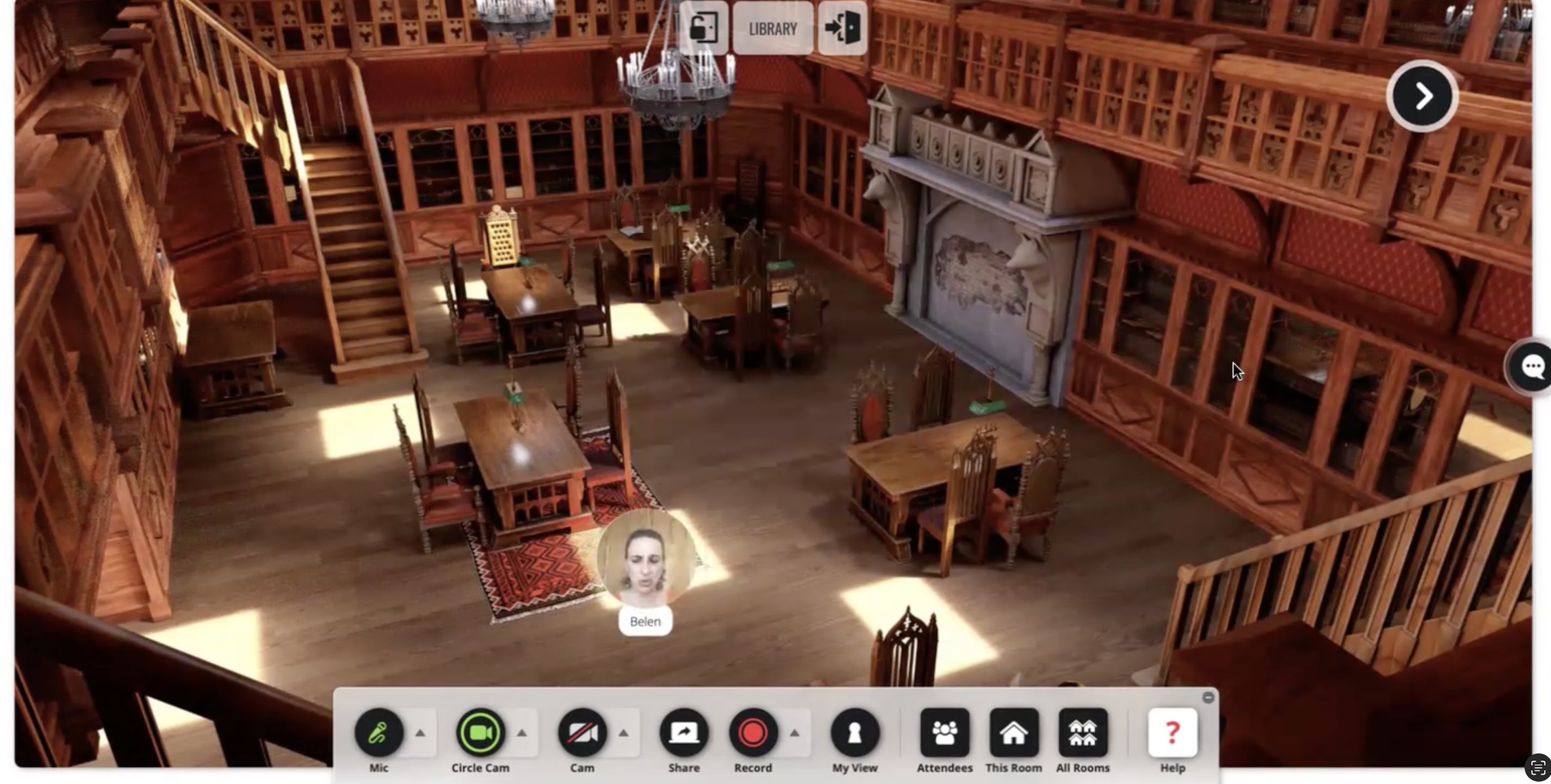
When you meet with the group, you’ll gather in the library, the café… each space stocked with its own set of materials.
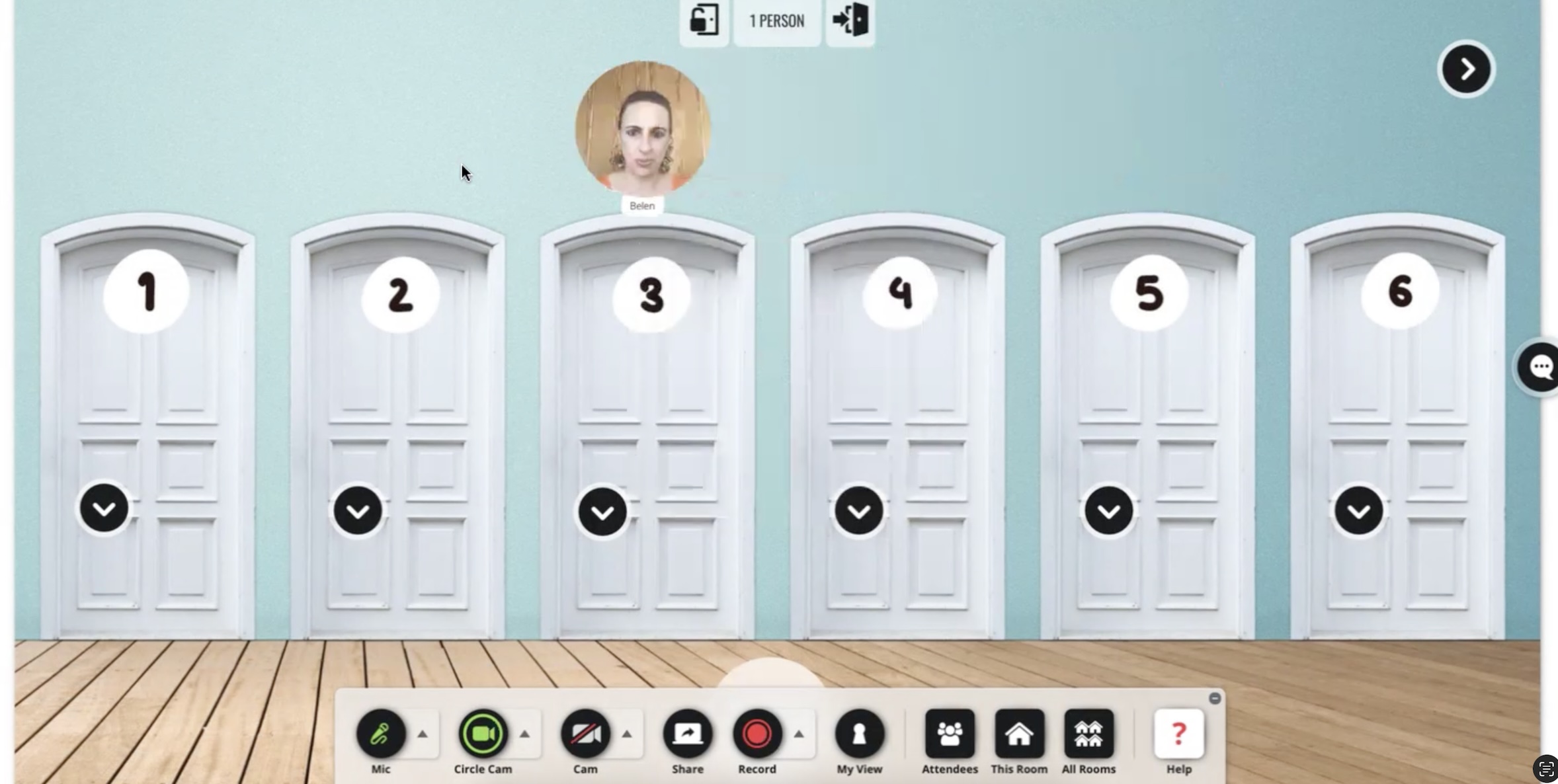
Here, you open the door to each room, no sudden interruptions. No more being cut off mid-sentence and thrown into another room without warning.
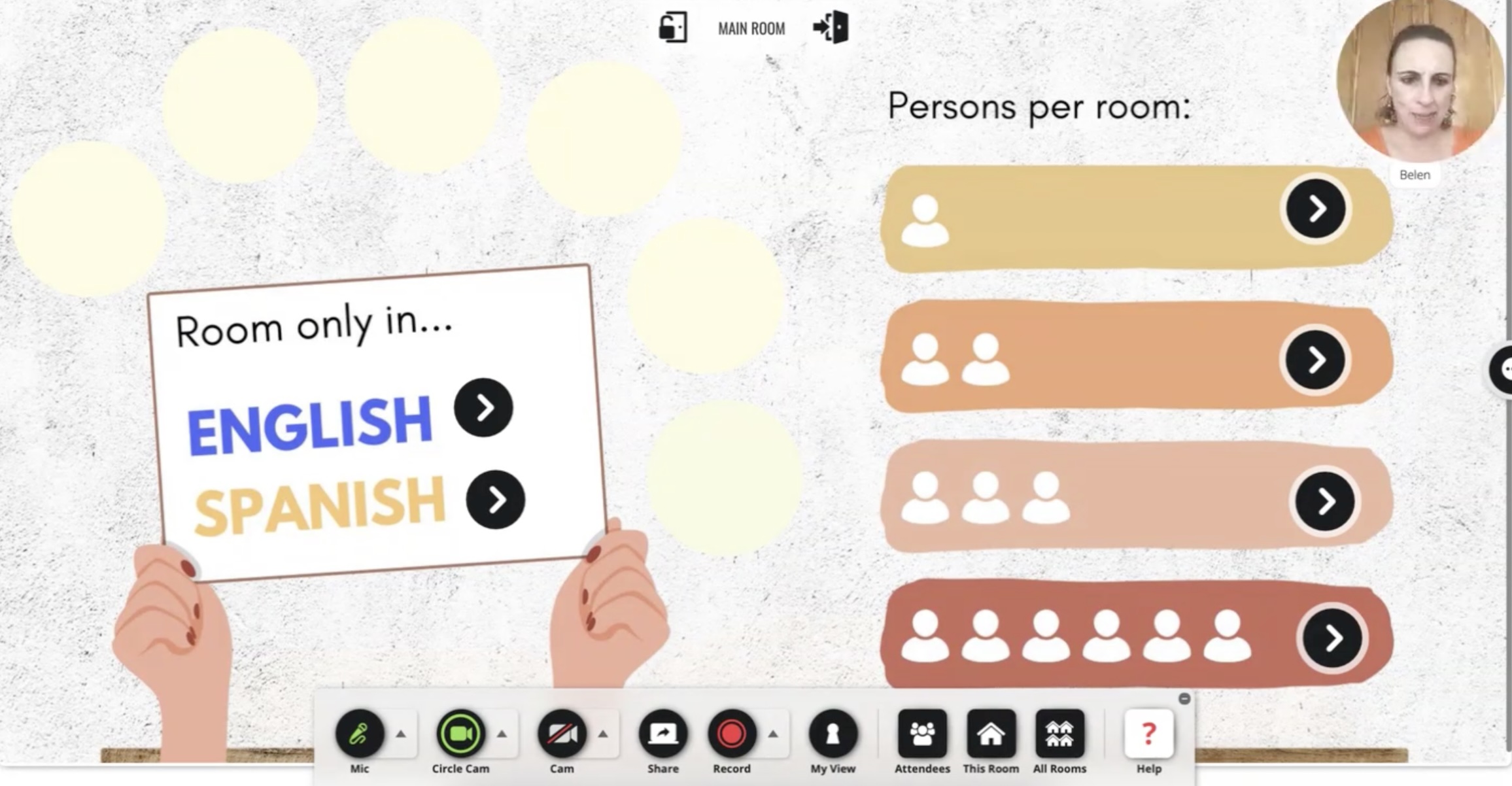
I can address everyone at once without stepping into any room. Perfect for quick instructions, announcements, or instant clarifications.
Inside the rooms you’ll find timers and all kinds of little gadgets that make the experience smoother… and a lot more fun
How the course works:
You take part in live, guided English–Spanish exchanges, alternating between weeks of autonomous pair work and group sessions.
I’ll always be there live to guide you.
For your pair-work weeks, you’ll have a practical guide with ready-to-use activities and instructions in both languages.
The first 2-hour session will be in pairs, followed by a group session.
By the time the exchanges start, you’ll be ready: you and your foreign partner will have had a 30-minute personalized session with me to discuss any concerns and get set up for success.
Still planting, or ready to harvest?
Out there, life is happening...
People chatting in different accents. People struggling to understand each other but trying anyway. People feeling good about lending a hand.
Meanwhile, your Spanish time is stuck in rehearsal mode, as if you were forever preparing for the “real show”, for that distant moment when you’ll finally have to speak with foreigners.
You’ve rehearsed long enough. Isn’t it time you stopped planting and started enjoying the fruits of your work?
Don’t Waste Your Time.
From where I stand, you’ve got four options.
You can keep studying endlessly, drawing up diagrams and notes just to calm yourself down—or maybe to keep up the illusion. It’s the dream for many: speak Spanish like a native… without ever speaking to one. Tempting, right?
You can keep joining classes where everyone speaks your language, where there are no native speakers to challenge you, no cultural surprises to push you forward, no real role for you to play. Just rehearsals, waiting for “someday.”
If you’re satisfied with the Spanish you already know and don’t care about connecting with people from other countries who want to know you, learn from you, and even go out of their way to help you... then maybe you don’t need what I offer.
But if everything you’ve tried so far hasn’t given you even the slightest glimpse of real progress… maybe it’s time for a change.
And sure, you could make that change by improvising: casual exchanges with no structure, no plan, no activities with clear goals. You’d pick up a little, sure.
Enough to survive. But is “getting by” really what you want?
It’s taken me twenty years to put together material that really works. And I’ve reshaped everything I know so it fits perfectly into today’s exchange format, whether you’re in pairs or in groups.
Do you honestly have the time to build such a collection yourself, and adapt every single piece? Maybe if you spend hours online hunting for cookie-cutter activities, you could pull something together.
But why would you?
Let me save you the struggle.
I’ve already done the hard work—creating loads of activities designed for non-teachers, and guiding live groups again and again.
I don’t know if this service is the exact match for where you are right now. What truly matters is that you invest in a solution and find a professional you feel comfortable working with.
And above all…
Pick a person who truly loves what they do, who’s excited to guide you, who brings energy and passion, and who’s genuinely invested in your progress.
At home, it’s always the same: you, your routine, your thoughts, your struggles. Nothing fresh or exciting can grow in that kind of soil. But step into a space filled with people on the same journey, eager to understand and connect across differences, and suddenly your world feels different.
Don’t you think your perspective would change?
Wouldn’t the way you see yourself speaking Spanish change too?
What if that shift alone gave you results you’ve never reached?
It takes a very special person to truly appreciate the real value of The Talkaholics. I’m selective about who I choose, and I’m looking for only a few. If you believe you might be a good fit…
Request your access interview right now.
If your profile fits, I’ll invite you to join the groups currently being formed while you read this.
I want to maximize my brain’s potential through structured exchanges with Spanish speakers, both in pairs and in groups, led by a teacher who knows how to bridge cultures.
In The Talkaholics, I have my own virtual room for chatting with my partner, plus a teacher-mediator at my side. Together, we design a personalized roadmap using the non-teachers’ guide. With this plan in place, my conversations flow smoothly—I avoid the stress of improvising everything.
The guide instantly triggers “The Triple Agreement”, boosting fluency and pronunciation while helping me overcome my fear of speaking.
The Talkaholics provides everything needed to improve together: detailed learning instructions, ready-to-use activities, and personalized support.
One week I have private sessions with my partner, the next week we join group meetings: guided by a teacher-mediator, we learn to recognize and navigate potential cultural misunderstandings.
I understand that I will lose the opportunity to join if the few available spots run out.
Without any luxuries, you can spend a month in Spain for 1500 euros.
(flight from Spain 150 euros, rented room 700 euros, supermarket food 250 euros, bus or metro 100 euros, extras 300 euros).
With 1500 euros you could get around 100 hours of group Spanish classes at any academy or online course.
Which of these two options would you invest in?
Those who decide not to get on a plane have asked themselves questions like these:
How often do locals in their country repeat things as many times as necessary, like a teacher does in class? Does this really happen for 100 hours in a month?
Those who decide to get on a plane have asked themselves something else:
In class, I speak Spanish with classmates who share my language, without natives to learn how to behave in their culture.
Whether you stay in your country or decide to go abroad, let me ask you this:
Are you ready to carry the full responsibility of adapting to natives on your own?
Misunderstandings at work meetings, with family, while traveling…
In another country you can’t ask about everything and in culture classes at home, you only learn theory, there are no natives present.
If a cultural mediator traveled with you at all times, they would spot misunderstandings and warn you. But an interpreter costs between 80 and 150 euros per hour.
Now, think about guided Spanish-English exchanges:
Structured language training, just like a class, but not only with classmates who speak your language.
Real conversations with natives, like being abroad, but without leaving home.
Structured cultural training, like a course, but 100% practical thanks to native speakers being present, and with my cultural mediation in situ… like nowhere else!
Three services in one, all enhanced.
How much would you pay for all this in 12 sessions of 2 hours over 3 months?
A total of 24 hours of guided Spanish-English exchanges, both in pairs and in groups.
Consider this…
An interpreter at your service for 24 hours would cost between 1920 and 3,600 euros.
One month in Spain costs 1500 euros.
This?
360 euros
12 sessions of 2 hours each.
In 3 months.
If you’re a Spanish teacher and want your students to connect with those of an English teacher, I can help you plan the sessions, with ready-to-use materials and customized virtual rooms. Book a video call, and I’ll go over all the details, including the price.
What past participants say:
You already saw the previous video testimonials when you signed up. I can show them to you again when we meet in a video call.
For years, you’ve been on the same path. You’ve worked hard to break the cycle, but lately, only small steps forward have come.
What I’m offering is a break.
I’m showing you how to finally change and leave behind all the battles you’ve fought so far. Accept my offer, take a breath, and move forward.
If you’re serious about this, you need to schedule an interview today, or risk missing out.